
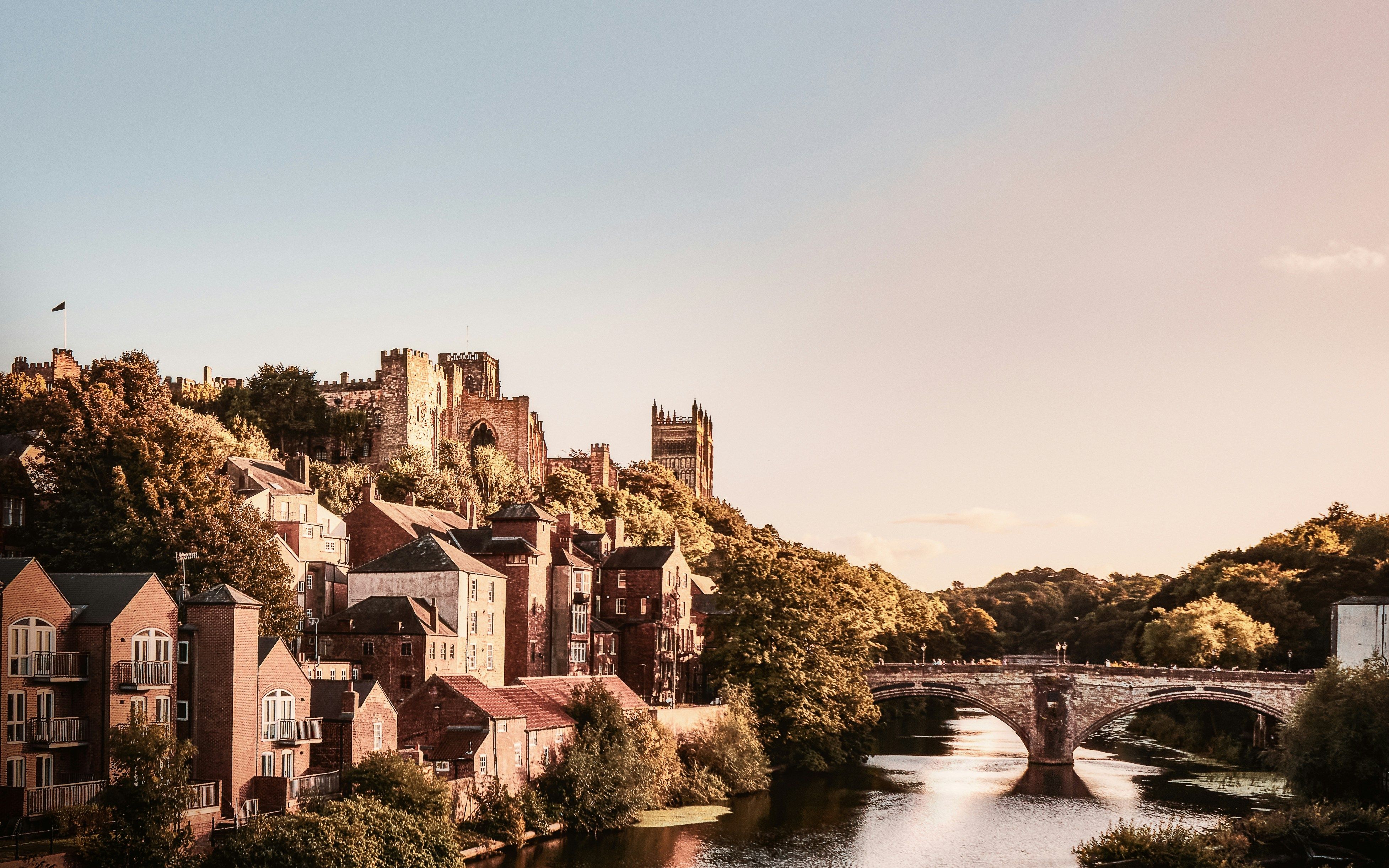
Durham
A cathedral city built on a peninsula of faith
Durham's story is inseparable from St Cuthbert. In AD 995, monks carrying the saint's body from Lindisfarne chose this dramatic wooded peninsula — almost entirely encircled by the River Wear — as his final resting place. A church was built, and a city grew around it.
The present Durham Cathedral, begun in 1093, is widely regarded as the finest example of Norman architecture in Europe. Its massive carved pillars, ribbed vaults, and the Galilee Chapel housing the tomb of the Venerable Bede make it one of the most important religious buildings in Britain. Together with the adjacent castle, it was designated a UNESCO World Heritage Site in 1986.
Durham Castle, originally built by William the Conqueror in 1072 as a show of Norman power, served as the residence of the Prince-Bishops of Durham — powerful figures who held both religious and secular authority over the region. Today it is part of Durham University, one of the oldest in England.
The city sits in a natural defensive loop of the river, connected by ancient bridges and surrounded by wooded riverbanks. Walking its cobbled streets, you sense the weight of a thousand years of continuous habitation — a place where power, faith, and landscape converge.